


44th Session of Indian Labour Conference Begins
| 44th Session of Indian Labour Conference Begins Dr. Manmohan Singh Calls for Sound Industrial Relations Shri Mallikarjun Kharge Stresses upon skill Development |
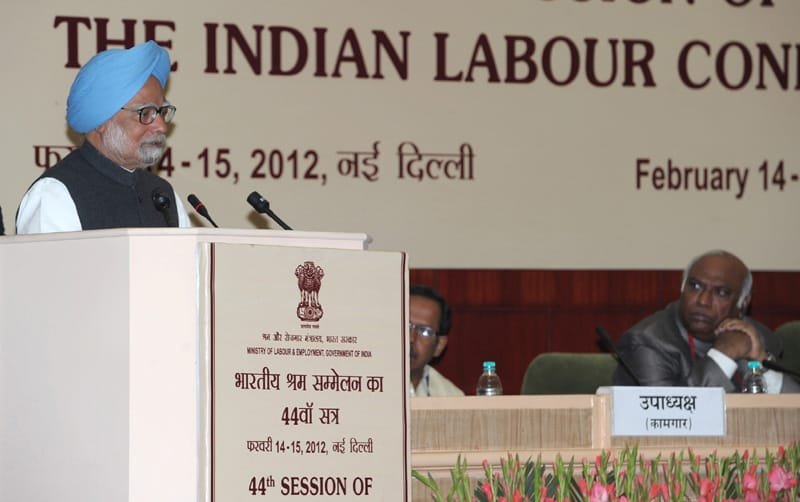
| The 44th Session of the Indian Labour Conference, an important forum of the tripartite consultative machinery, was inaugurated by the Prime Minister Dr. Manmohan Singh in New Delhi, today.. The two day conference is being attended by State Labour Ministers, Trade Union Leaders from all the recognised All India Trade Unions, Representatives of all India Employer’s Organisations, Officials from Central Ministries, State Governments and PSUs. The Conference focuses on 3 key issues: Minimum Wages, Social Security and Employment and Employability.In his inaugural address, the Prime Minister emphasized that the country cannot achieve the goal of faster and inclusive growth and building a modern industrialized economy without having a sound industrial relations in the country. The industry, the workers and the government must work harmoniously and in partnership with each other, if the country is to achieve rapid progress and the Indian Labour Conference has to play an important role in this regard. He said that as Prime Minister, he had participated in the Indian Labour Conference for the first time in its 40th Session held in the year 2005. At that time he had said that the UPA Government was committed to ensuring the welfare and well-being of all workers, particularly those in the unorganized sector. He reaffirmed that commitment today and further informed the gathering that the UPA government has worked hard to translate this commitment into action in the last seven and a half years.He further said that the Rashtriya Swasthya Bima Yojna, which now covers more than 2.5 crore Below Poverty Line families in the unorganized sector, has been extended to cover construction workers, street vendors, MGNREGA beneficiaries, Beedi workers and domestic workers. The Mahatma Gandhi National Rural Employment Guarantee Scheme has also succeeded in checking distress migration substantially from our villages and brought about an improvement in the wages of rural workers. For ESIC coverage, the threshold limit of establishments has been brought down from 20 to 10 persons. Large-scale infrastructure and IT modernization, provisions for super-specialty treatment and other such measures have led to an improvement in the ESIC’s services to the beneficiaries. The Employees Provident Fund Organization has taken major steps to widen its coverage especially among construction workers and computerising records of its 60 million members significantly improve quality of services. The Prime Minister while according special importance to the issue of employment and employability emphasised the need to provide gainful opportunities to large number of young people who join the work force every year by equipping them with demand driven marketable skills. He shared that the rapid growth of the Indian economy since 2004 has clearly brought out the shortcomings of our skill development processes. Recognizing this problem, the government has launched the Skill Development Mission, which seeks to bring about a massive increase in the number of formally trained workers through Public Private Partnership. The government is also in the process of designing and developing a National Vocational Qualification Framework for competency standards, affiliation and accreditation. The efforts of the various Ministries/Departments that are involved in skill training are being coordinated to expand outreach and increase accessibility. The Ministry of Labour & Employment has also embarked upon the task of establishing 1500 New Industrial Training Institutes and 5000 Skill Development Centres in the country during the next three years. In this context, he also called upon the Private Sector to engage itself much more vigorously if the country has to overcome this challenge. Dr. Manmohan Singh said that the UPA government is fully committed to strengthen the labour laws and ensuring their compliance for securing the welfare of workers. He informed the august house that the government is currently in the process of amending the Factories Act, 1948, because of number of developments since 1987, when the act was last amended. These concerns especially related to industrial disaster mitigation, rehabilitation and compensation for industrial workers and other affected persons and to facilitate the ratification by India of several ILO conventions. He further highlighted that often it is expressed that the Indian labour policies unduly protect the interests of the currently employed labour and act against the expansion of employment in the organized sector. He said that this view has lost its importance in recent years as more and more State governments have become considerably more flexible in their approach to labour restructuring and rationalization. The Prime Minister also mentioned that women are our most underutilised resources as the female labour force participations rates in the country is extremely low and have remained more or less constant over the past decades. In order to bring more women into the workforce, it is necessary to understand the constraints that they face in balancing their family and work responsibilities and proactively bring legislative and other changes to enhance their labour force participation. He also said that the present system of ensuring welfare and well-being of migrant workers are weak and need to be strengthened. In this context perhaps the Aadhar numbers can become a significant device in ensuring portability of the rights of migrant labour. He concluded his speech by wishing all the very best to the deliberation of the conference and hoped that the deliberation will be very useful and productive and will build upon the work of the previous Sessions of the Indian Labour Conference. In his welcome address, Shri Mallikarjun Kharge, Union Minister of Labour and Employment while extending a very warm and hearty welcome to the Prime Minister expressed that ILC has contributed immensely to the formation of our country’s labour policy and launching various schemes for the workers. He said that Employment and employability is a priority area of our Prime Minister and the Skill Development Council headed by him has set a target of skilling 50 Crore persons by the year 2022. This is a huge challenge because of our large informal sector and this requires innovative approach for imparting of skills. In the context of Social Security, the the Minister highlighted that government is providing maximum emphasis to expand the coverage of Social Security. He said that providing assured employment under MGNREGA for 100 days and covering around 12 crore persons under Rashtriya Swasthya Bima Yojana are some of the flagship initiatives of the current Government, which have no parallels in the world. He said that minimum wage is one of the important means of safeguarding the interests of workers in the unorganized sector and the Ministry of Labour & Employment is continuously striving to ensure the safety of workers and protection of labour rights. He concluded his address by expressing his hope that the 44th Session of Indian Labour Conference will be remembered for its important outcomes and worthy contributions towards the Indian economy in general and the working class in particular. The Labour Ministers of State Governments, Central Trade Union Leaders, Employers’ representatives, and Officials of the central and state governments also deliberated on minimum wages, social security and employment and employability and other issues relating to the world of work. |